On a warm, breezy summer evening on August 29, 2026, a gathering took place in Bélang village, Mingmang, Dhemaji. A group of men, mostly in their thirties, including me, came together and discussed the heavy rains that had recently caused flooding in Nepal and Sibsagar, Assam. I listened to the discussion quietly, feeling the weight of the stories of towns, villages, and people being washed away by heavy waters. It had been a week since I returned from Guwahati to Bélang, my home. Within a week, I encountered many such discussions and conversations among the villagers, fuelled by fears about the 2000MW dam built on the river Obonori, a few kilometers away from the village. The discussions focused on the potential threat the dam poses if a natural disaster, such as an earthquake or landslide, were to occur. Recent floods, driven by climate change and human activities in the Himalayan region, have only heightened these concerns. The salient question that arises here is why the Indian state pushes hard to construct this destructive development infrastructure in these areas despite the increase in dam disasters in the Himalayan region, and what does this forced construction imply? Moreover, a more significant question is: what role do ethnic organizations that represent the affected communities play in asserting their voices against these projects?
Anticipating disaster
That evening, the conversation went on for quite some time, and a young man, Migom, who is a construction worker at the dam site, looked at me and said, “Do not settle down in Gogamukh. Are you guys thinking of buying land there? Please reconsider. You are probably already aware of the floods in Nepal and Sibsagar. We are also quite sure that the dam near us might collapse someday.” The others nodded in agreement with him. Migom’s brother, who was also present there, added with greater certainty, “Dam élé manggom Adi elé bidyagyerung, kadanlang,” (If not the dam, there will be a breach in the hills). These were statements I have often heard since I was young, particularly during the early years of the anti-dam movement against the SLHEP in the 2000s. Reportedly, many families have been reconsidering calling Gogamukh home, and many sold their land and migrated elsewhere due to these concerns and the anticipation of a dystopian future. In recent years, landslides have occurred at the dam construction site, disrupting the river’s regular flow and causing it to dry up, and people downstream have already grown apprehensive about a darker future. Migom continued and said, “Do you want to know why I am raising issues on the dam? “I have been involved in building the dam for over four years. I know where it is located and how unstable the geology is. I also do not trust the way it is constructed. There are frequent landslides at the construction site, even after all this time. Even after the dam has begun operating, construction work at the dam site continues due to the collapse of guard walls and frequent landslides.”
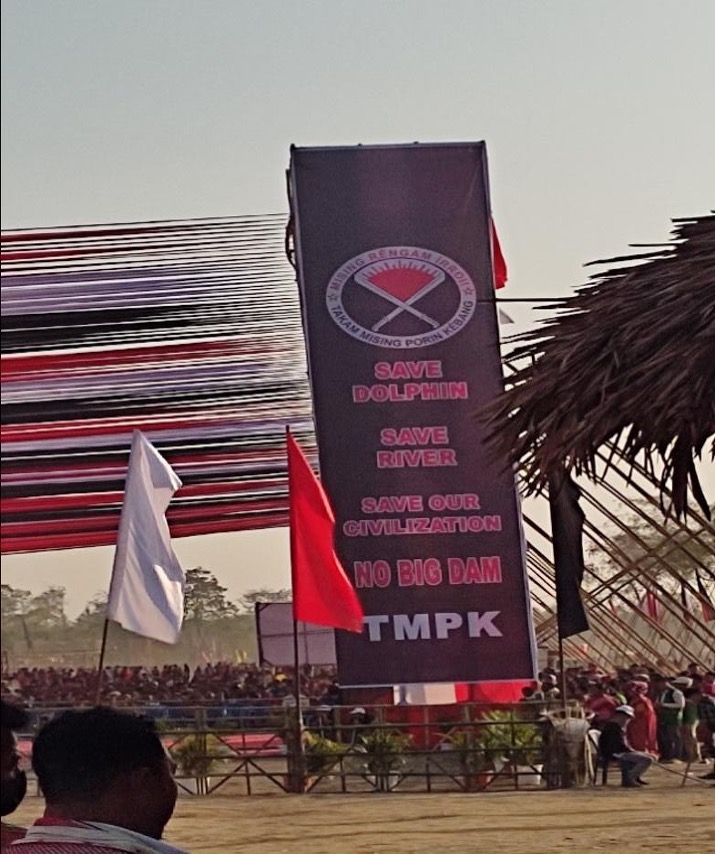
Fig. 1: A hoarding depicting the anti-dam stance of TMPK in a recent meeting held in Gogamukh in 2023 (Source: Author)
Another construction worker from the village pointed out, “There are already some cracks in the dam’s concrete. I am certain that a disaster like Nepal could happen here.” In such a situation, just like many other times in the past (since the early 2000s), we wondered whether our village would be safe if the dam broke. We started mapping the hazard-prone areas that could be most affected. Some mentioned Gogamukh, Majuli, and Lakhimpur, especially the areas where the Mising community lives along the riverbanks. In the end, we agreed that our village, Bélang, lying east of the dam, might escape the worst of the flood, but we were deeply worried about the downstream villages and Gogamukh town, where each one of us has families, relatives, and friends in the hazard-prone areas. The conversation seemed to suggest that everyone was waiting for doomsday. In the absence of active protests by community organizations and the Indian state’s stern push for hydropower to combat climate change, the communities downstream along the Obonori River seem to have resigned themselves to being rendered disposable in the face of such a disaster.
The Rush for Hydropower in Northeast India
Across the Northeastern region, numerous communities have raised concerns about dam-related disasters, sparking widespread protests against these projects. The Brahmaputra Valley has suffered unprecedented downstream flooding due to dams constructed in the surrounding hills—including the Ranganadi Dam in Arunachal Pradesh, the Kapili Dam in Karbi Anglong, the Doyang Dam in Nagaland, and Bhutan’s Kurichu Dam—that have devastated multiple districts downstream in Assam.
Furthermore, recent dam disasters in Sikkim, Uttarakhand, and Nepal have heightened anxiety among communities across the Himalayan region. These protests are further fuelled by community awareness of the Himalayas’ fragile geology and lessons drawn from historical seismic events. For instance, after the SLHEP dam on the Obonori was proposed in the early 2000s, public opinion had shifted against dam construction. The shift concerns the constellation of anti-dam movements that proliferated in the region.[1] For instance, the anti-dam movement on Obonori drew on examples of protests against the Mapithel dam in Manipur and the Siang, Dibang, and Tawang Chu projects in Arunachal Pradesh. Similarly, there have been protests against similar projects in Sikkim’s Teesta Basin.
These protests highlighted the negative ecological impacts on the region’s biodiversity, the threat of dam-induced downstream flooding, and the risk of the dam collapsing due to its location in a highly seismic zone. All these issues raised by the anti-dam movements have been reflected in the dam disasters across the Himalayan region. Moreover, studies show that climate change, coupled with dam disasters, would increase community vulnerability, leading to a double exposure. A prominent recent example is the strong opposition mounted by the Adi community in the Siang basin against the proposed dam on the Siang River.
Yet, the Indian state seems uninterested in the issues raised by the anti-dam movements. Despite disasters stemming from dam construction across the Himalayan region, the government of India has consistently found a way to legitimize its push for hydropower. For many decades, dams in the Northeast have been pushed forward to bring development to a supposedly underdeveloped region. It has legitimized the move to increase hydropower by portraying dams as a source of renewable energy to fight climate change. Moreover, dam construction is legitimized as a geopolitical policy to counter China’s dominance in the region and to compete in the energy market in Southeast Asian countries such as Myanmar and Bangladesh. Beneath these justifications made by the Indian state lies the ongoing process of turning the region into an extractive frontier. The process dates back to colonial times and has been at the expense of communities and biodiversity. They place a burden on the affected population to bear the unequal risk imposed on them.[2] These communities are left disposable at the margins of the imagined nation. Such a process of making people disposable is rooted in the discourse of how the Northeastern region has been perceived. It often lies in the racialized territorial governance of the colonial and post-colonial Indian state, where there is a civilizational idea of controlling the unruly communities of an unruly region.[3] The Northeastern region and its people have been historically perceived as backward, underdeveloped, unruly, and in urgent need of national integration.[4] The aggressive push for development and the rhetoric of national security through dams reveal how the region is governed with a racialized lens.
The Role of Community Organizations
Recent studies have largely observed that anti-dam movements have declined worldwide.[5] This is due to the undemocratic turn of the ruling regimes in recent times, resulting in the discrediting of activists and protestors as anti-national and anti-development, and threatening these activists’ lives. The state’s monopoly over violence to promote ‘development’ has resulted in a dangerous situation under which social movements dwindle and struggle to sustain themselves amidst an authoritarian regime in India. The movement against the SLHEP has been met with violent repression by the state.[6] The movement was portrayed as having ties to Maoist insurgencies. It has led to the jailing of many anti-dam protestors.[7] It is evident that the state played a crucial role in these developments. The lack of active protest is rooted in the violence perpetrated on the people by the state. It indicates that, in the guise of development, the Indigenous people have been threatened with violence by state security forces. In such a context, sustaining protest is challenging. In addition, elsewhere, we have argued that Indigenous community organizations face pressure and expectations to protest destructive development projects. However, they may not always do so because of varied grounded material and historical realities.[8]
However, amid increasing disasters in the Himalayan region that jeopardize Indigenous communities, we must also critically analyze the role of community organizations that represent affected communities. The Takam Mising Porin Kébang (All Mising Students’ Union) and other organizations, such as the Mising Mimag Kébang (Mising Revolutionary Front), are bodies that represent the Mising population and bear a significant responsibility for tackling the issues the contemporary Mising community faces. These organizations played a crucial role in the anti-dam movement at its peak. However, there has been a drastic decline in the protest movement, as evidenced by their electoral alliance with the Bharatiya Janata Party, the ruling party of the current regime. This alliance could be seen as a negotiation exercise by the Mising organizations in pursuit of their historical demand to be granted the Sixth Schedule under the Constitution of India. However, while this negotiation seems logical for securing the socio-economic and political rights of the Misings under the Sixth Schedule, the decline in protests against these destructive development projects has negative impacts that have the potential to erase the entire Mising community residing along the riverine tracts of Siang and Obonori.[9]
Amid heightened dam-induced disasters and rising risks of development-induced destruction across the Himalayan region, sustained resistance to these projects appears essential. Community organizations must take the lead by creating space for people to speak out against the historical and ongoing injustices they face. Yet the recent silence and passivity of these organizations threaten to deepen the destruction of the community. This silence renders the Misings more disposable and enables the government to advance its destructive agenda, while poor and marginalized people bear the risks and costs of these projects. In this context, there needs to be a renewed analysis of tribal politics in Assam and further study of how the current form of negotiations could hamper the community’s broader interests amid climate change and increasing disasters in the Himalayan region.
[1] Chandan Kumar Sharma, “Dam, ‘Development’ and Popular Resistance in Northeast India.” Sociological Bulletin 67, no. 3 (2018): 317–33. https://doi.org/10.1177/0038022918796942.
[2] Mabel Denzin Gergan, “Disastrous Hydropower, Uneven Regional Development, and Decolonization in India’s Eastern Himalayan Borderlands,” Political Geography 80 (June 2020): 102175, https://doi.org/10.1016/j.polgeo.2020.102175; Amelie Huber, “Hydropower in the Himalayan Hazardscape: Strategic Ignorance and the Production of Unequal Risk,” Water 11, no. 3 (2019): 414, https://doi.org/10.3390/w11030414; Costanza Rampini, “The ‘Double-Exposure’ of Riverine Communities in Northeast India to Dams and Climate Change,” Environmental Development 54 (June 2025): 101142, https://doi.org/10.1016/j.envdev.2025.101142.
[3] Gergan, “Disastrous Hydropower, Uneven Regional Development, and Decolonization in India’s Eastern Himalayan Borderlands.”
[4] Mabel Denzin Gergan, “The Universal Meets the Himalayan Particular: Indigeneity, Race, and Decolonization in India,” Critical Asian Studies57, no. 4 (2025): 535–59, https://doi.org/10.1080/14672715.2025.2530556.
[5] Amita Baviskar, Nation’s Body, River’s Pulse: Narratives of Anti-Dam Politics in India, 150, no. 1 (2019): 26–41, https://doi.org/10.1177/0725513618822417; Bengt G. Karlsson, “Into the Grid: Hydropower and Subaltern Politics in Northeast India,” in Staking Claims: The Politics of Social Movements in Contemporary Rural India, First, ed. Uday Chandra and Daniel Taghioff (Oxford University Press, 2016).
[6] “10 Injured in Firing on Anti-Dam Agitators,” Archive, The Assam Tribune (Guwahati), September 15, 2010, https://assamtribune.com/10-injured-in-firing-on-anti-dam-agitators.
[7] Anupam Chakravartty, “Subansiri Dam Protests: Akhil Gogoi Goes on Indefinite Fast,” Down To Earth, May 21, 2012, https://www.downtoearth.org.in/environment/subansiri-dam-protests-akhil-gogoi-goes-on-indefinite-fast- 38257.
[8] Pranab Kumar Pegu and Vasundhara Jairath, “Indigenous Communities and Development: The Mising People and Dam Construction in Assam, India,” Critical Asian Studies, October 17, 2026, 1–19, https://doi.org/10.1080/14672715.2026.2744625.
[9] This electoral alliance and negotiation politics between the national parties and local community parties. Especially, the historical demands pertaining to the Sixth Schedule in the context of tribal communities and their negotiations with the Government of India warrant further engagement.

Be First to Comment