One incident from my childhood in our village has remained etched in my memory. The parents of one of my cousins decided to send him to Lakhimpur to continue his studies in an English-medium school. As soon as the rest of us in our peer group heard the news, we began teasing him about how lucky he was to be leaving the village for a new school and a new life. But it was a remark from one of our older cousins that stayed with me. Smiling mischievously, he said, “Wah! Now you will become a town person and speak only in Assamese.” At the time, it was just another teasing comment. Yet, for reasons I could not have explained then, it lodged itself somewhere in my mind and has remained with me ever since.
Later, upon reflection, I came to understand where his comment was coming from. What I have observed is that almost all the children who leave the village at a young age (under ten years old) tend to speak Assamese or Hindi (depending on where they were educated) as their primary language of communication. Some of them understand the Mising language but cannot speak it, while others can speak only in broken sentences. The reason is that, after migrating to urban areas, Assamese or Hindi becomes the language used for everyday communication. Gradually, they begin speaking these languages with their parents, family members, and friends within the community. This has become a prevalent practice among members of the Mising community living in urban areas.
Language vitality refers to the degree to which a language is actively spoken and maintained within a community. It refers to the metaphorical health or life of a language by measuring the number of active speakers, intergenerational transmission, and its social and cultural significance. It assesses the likelihood of a language’s survival or extinction over time. Sociolinguist Joshua Fishman, known for his 8-level Graded Intergenerational Disruption Scale (GIDS), considers family and community transmission to be the deciding factor in language vitality. To him, a vital language is one that functions sustainably across everyday social domains without systemic disruptions in its transmission to younger generations.
Studies have shown that, in multilingual societies, local languages often come under threat due to urbanisation, mobility, and the dominance of national languages. A study conducted in Papua New Guinea, a nation known for its exceptional cultural and biological diversity, demonstrated that the establishment of a national language (Tok Pisin) and the influence of religion (Christian values) have weakened the use of local languages such as Buang and Taiap (Kulick, 1992; Romaine, 1995). Similar developments have been observed in Botswana and Indonesia, where younger speakers were found to consistently favour the national language over their local languages, driven by the expansion of formal education, mass media, and internal migration (Arua & Magocha, 2002; Setiawati et al., 2026). These factors have also contributed to the disruption of intergenerational transmission, particularly in urban settings, as the pursuit of better education, employment, and digital communication has led younger speakers to favour the national language over local or regional varieties (Pramuniati et al., 2025).
While language endangerment may appear to be an inevitable outcome of modernisation, R. Karthick Narayanan argues otherwise. Narayanan is critical of the leveling of Indian languages under standardised frameworks conventionally used to assess language vitality and endangerment, contending that the realities of multilingual practices in India are considerably more complex than such models allow. In his work Multilinguality, Vitality, and Endangerment, Narayanan (2025) argues that these standardised assessment frameworks rest on a Eurocentric conception of language use rooted in environments of monolingualism. He substantiates this argument through a field-based examination of the Toda and Kota languages—spoken by small, marginalised linguistic communities in the Nilgiri Hills of Tamil Nadu whose languages are transmitted largely through oral tradition—demonstrating that structural inequality, rather than modernisation itself, is the principal driving force behind linguistic displacement in India. For multilingual societies more broadly, he advocates a grounded approach informed by Einar Haugen’s notion of language ecology, alongside greater attention to wider socioeconomic influences.
Nevertheless, language vitality and endangerment frameworks continue to offer an accessible means of understanding the condition of a language, and, in this case, that of the Mising language of Assam. With this in mind, I seek to assess the vitality of the Mising language from an emic perspective, drawing on my own experience as a native speaker of the language.
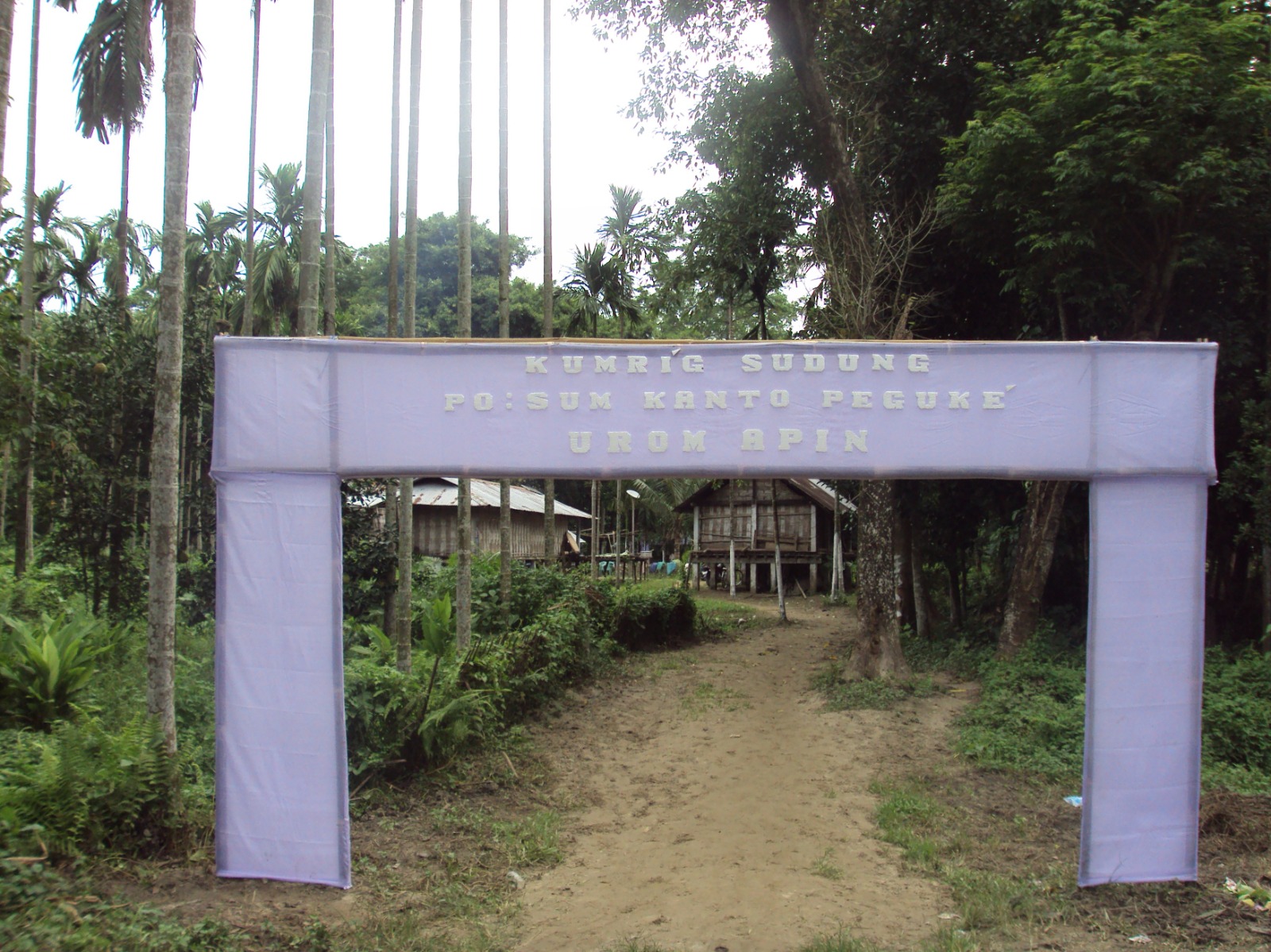
Image- An entry gate for Urom Apin (a mortuary rite) in a Mising household. In Urom Apin, people still predominantly use the traditional language (Photo by author)
When assessing whether a language is thriving or declining, researchers often employ domain-based approaches. The United Nations Educational, Scientific and Cultural Organisation (UNESCO) Language Vitality and Endangerment(LVE) framework (2003) identifies nine domains for assessing the vitality and degree of endangerment of a language. From these nine domains, I focus on the first five to assess the vitality of the Mising language. These five domains are: (1) Family and Home, (2) Public Domain and Administration, (3) Education, (4) Media and Information, and (5) Workplace and Marketplace.
Family and Home: This domain is the most significant. It is the first place where a language is taught to a newborn and perhaps the last where the death knell of a language is sounded. Kutum (2025), quoting a report by the United Nations Educational, Scientific and Cultural Organisation (UNESCO) titled Atlas of the World’s Languages in Danger(2011), in which the Mising language was classified as “definitely endangered”, states that it is no longer learned as a mother tongue or spoken at home. This has also been my observation, especially among educated urban Mising families.
The first generation of educated Mising people who settled in urban areas spoke the Mising language with their parents and spouses. Their children (the second generation), however, acquired Assamese or Hindi as their first language at home. This occurs as a result of gradual assimilation into the new environment. Parents fear that their children will fall behind in school and that their academic development will be hindered if they are unable to communicate with their peers. As Doley (2025) argues in Critical Analysis of the Indian School Curriculum from the Perspective of Tribes, children from linguistic minorities often struggle in school because of language barriers, and many of these parents have experienced such situations themselves. Moreover, it is often more convenient for parents to teach one language at home rather than two languages (Mising and Assamese) simultaneously.
These children, however, understand the language because they are exposed to their parents and grandparents conversing in it. They acquire words and phrases through this exposure but are unable to converse fluently. The children of this generation (the third generation) often do not understand the language at all, as their parents themselves did not acquire it fully. They may be aware of the language and have some familiarity with it through community gatherings or visits from relatives, but they do not possess the same level of linguistic competence as their parents and are unable to follow conversations. As more Mising people receive education and settle in urban areas, this pattern is becoming increasingly widespread.
Another factor contributing to the loss of the family and home domain for Mising language use is inter-community marriage. Children from inter-community marriages often acquire the dominant mother tongue of one of the parents (Assamese or Hindi) or English, if it is the common language of communication between the parents. Only in rare cases do children acquire both parents’ mother tongues. As inter-community marriages become more common, so too does the loss of Mising as a mother tongue for the next generation.
Public Domain and Administration: According to my observation, this domain perhaps ranks second in terms of the use of the Mising language. At public gatherings among Mising people, considerable effort is made to speak the language. However, speakers often have to switch to other languages—mostly Assamese—because they struggle to find certain words in Mising owing either to limited vocabulary or to the absence of equivalent terms in the language.
In administrative offices and organisations such as the Takam Mising Porin Kebang (TMPK), the Mising Autonomous Council, and other local bodies, there is a clear effort to use the language as much as possible, as promoting and revitalising the Mising language forms part of their mission. These organisations have begun printing and distributing annual calendars, templates, magazines, and other publications in the Mising language. Nevertheless, these efforts remain limited and fail to reach the majority of the Mising population. They also frequently have to switch to Assamese, as it is often the more practical language for communication.
Education: Formal education in the Mising language was an unattainable reality for many years, perhaps even centuries, because the language was transmitted predominantly through oral tradition. One of the major obstacles was the absence of a written script. Through the influence of missionary work, the Roman script was adopted with a phonetic and phonemic system suited to the language. Gradually, more academic works on the language began to emerge.
A significant milestone in the development of the language was the publication of Tabu Taid’s Gompir Kumsung(2010), an expanded edition of A Dictionary of Mising Language, first published in 1995 by the Anundoram Borooah Institute of Language, Art & Culture (ABILAC) in Guwahati. Today, efforts are being made to provide formal education in the language at the primary-school level (Pegu, 2025), and diploma courses in the language are also offered at the university level (Kutum, 2025). However, there are still no schools or institutions dedicated exclusively to the development of the language. The establishment of a specialised institution for the research and development of the language would therefore be of considerable importance.
Media and Information: As part of the central government’s initiative to preserve the Scheduled Tribal languages recognised under the Constitution of India, All India Radio’s (AIR) station in Dibrugarh has been broadcasting weekly cultural programmes and news in the Mising language. At one time, these broadcasts were among the most eagerly anticipated weekly events in Mising households. Families looked forward to hearing their language on the radio, as it represented both a cultural achievement and a source of pride for the community.
However, with the proliferation of television and the internet, radio listenership has declined considerably. For many years, Mising-language cinema was the most accessible form of media for the community. A large proportion of the population had little access to television, and many did not understand Assamese or Hindi well enough to enjoy films in those languages. Consequently, Mising-language films served as their primary source of entertainment.
Over the past few decades, however, television and mobile phones have become increasingly accessible. As a result, more people have been exposed to programmes and entertainment in other languages, gradually reducing the reach and popularity of Mising-language cinema. In recent years, social media platforms such as Instagram and YouTube have provided younger generations with opportunities to create content in their native language. These platforms have become one of the most effective means of promoting and disseminating the language, particularly through music.
Workplace and Marketplace: The final domain I examine is the workplace and marketplace. In formal office environments, the Mising language is rarely spoken unless the workplace is an organisation such as the Takam Mising Porin Kebang (TMPK), the Mising Agom Kebang (MAK), or similar institutions. The language may also be used when two or more Mising colleagues are fluent speakers. Otherwise, communication generally takes place in the dominant regional languages.
A similar situation exists in marketplaces in urban and semi-urban areas. In rural settings, however, where neighbouring villages are predominantly Mising, the marketplace presents a contrasting picture. The language is commonly used, and even regular vendors and shopkeepers who are not native speakers often learn basic words and phrases in Mising to attract customers and negotiate with them.
Based on UNESCO’s classification system, I would assess the vitality of the Mising language as vulnerable in monocultural settlements (most Mising villages), where most children still speak the language but its use is restricted to certain domains. The situation changes markedly in multicultural settlements (towns and cities), where the language may instead be classified as severely endangered. In such contexts, the language is spoken primarily by grandparents and the older generation, while the parent generation, although they may understand it, no longer speaks it to their children or among themselves.
Under the framework of the National Education Policy (NEP) 2020, the central government seeks to safeguard minority languages from being displaced by English and dominant state languages. However, the effectiveness of these measures remains open to debate. I am inclined to agree with Fishman’s assertion, as cited in Zui (2024), that no amount of government funding or school-based instruction can sustain a language in the long term if parents do not speak it to their children at home.
In today’s fast-paced world, language may be perceived merely as a means of communication, and the responsibility of passing on one’s mother tongue may even be regarded as a burden. However, this perspective captures only one dimension of what language represents. Language is itself a repository of knowledge. It preserves the history of a community and the legacy of its ancestors, carrying forms of knowledge that are intrinsic to that language. This is one reason why translation is often difficult and why translated works rarely have the same impact as the original.
For example, there is no exact equivalent of the Mising word tunggeng in Assamese, Hindi, or English. Words such as veranda or front porch may be used as approximations, but they do not accurately convey its meaning. Tunggeng refers to a specific architectural feature of traditional Mising houses. The knowledge embedded in this word is inseparable from that architectural tradition.
Language is culture. Indeed, it may even be argued that language is the primary manifestation of culture. There are many instances in which communities are identified by the language they speak. In some cases, when a language is lost, a culture is lost with it.
References
Arua, A. E., & Magocha, K. (2002). Patterns of language use and language preference of some children and their parents in Botswana. Journal of Multilingual and Multicultural Development, 23(6), 449–461.
Das, H. M., & Doley, T. (2024). A brief history of Mising language studies. International Journal for Multidisciplinary Research (IJFMR), 6(1). https://doi.org/10.36948/ijfmr.2024.v06i01.12440
Doley, J. (2025, August 30). Critical analysis of the Indian school curriculum from the perspective of tribes. Mising Community Researchers’ Collective
Kulick, D. (1992). Language shift and cultural reproduction: Socialization, self, and syncretism in a Papua New Guinean village. Cambridge University Press.
Kutum, R. (2025, June 1). How learning my Ané ké Agom (mother tongue) helped me reconnect with my roots. Mising Community Researchers’ Collective. https://mcrcindia.com/2025/06/01/how-learning-my-ane-ke-agom-mother-tongue-helped-me-reconnect-with-my-roots/
Lewis, M. P., & Simons, G. F. (2010). Assessing endangerment: Expanding Fishman’s GIDS. Revue roumaine de linguistique, 55(2), 103–120.
Narayanan, R. K. (2025). Multilinguality, vitality, and endangerment: Insights from the lived experiences of multilingual India. Cambridge Scholars Publishing.
Pegu, B. (2025, April 3). Introducing Mising medium in primary schools in Assam: Why is there a need for a tribal language act? Mising Community Researchers’ Collective
Phiranawong, S., Ungsitipoonporn, S., & Sandman, E. (2026). Assessing language vitality and analyzing factors behind language maintenance and language shift: The case of Hakka in Thailand. Asian Ethnicity, 27(2), 439–464.
Pramuniati, I., Mahriyuni, M., Hardini, T. I., & Hidayati, F. (2025). Language shift between generations: Regional-speaking parents raise Indonesian-speaking children in North Sumatra. Indonesian Journal of Applied Linguistics, 15(1), 102–115.
Romaine, S. (1995). Bilingualism (2nd ed.). Blackwell.
Setiawati, E., Yassi, A. H., Cholsy, H., Ardhian, D., Hambali, M., Widagdo, T. B., Sukardi, M. I., & Salamah, S. (2026). Language vitality assessment of Madurese in Probolinggo Regency, Indonesia. Cogent Arts & Humanities, 13(1), Article 2674308.
UNESCO Ad Hoc Expert Group on Endangered Languages. (2003). Language vitality and endangerment. Paper presented at the International Expert Meeting on UNESCO Programme Safeguarding of Endangered Languages, Paris, France, March 10–12, 2003.
Zui. (2024, November 16). How do we assess language vitality? The Language Closet.

Be First to Comment